
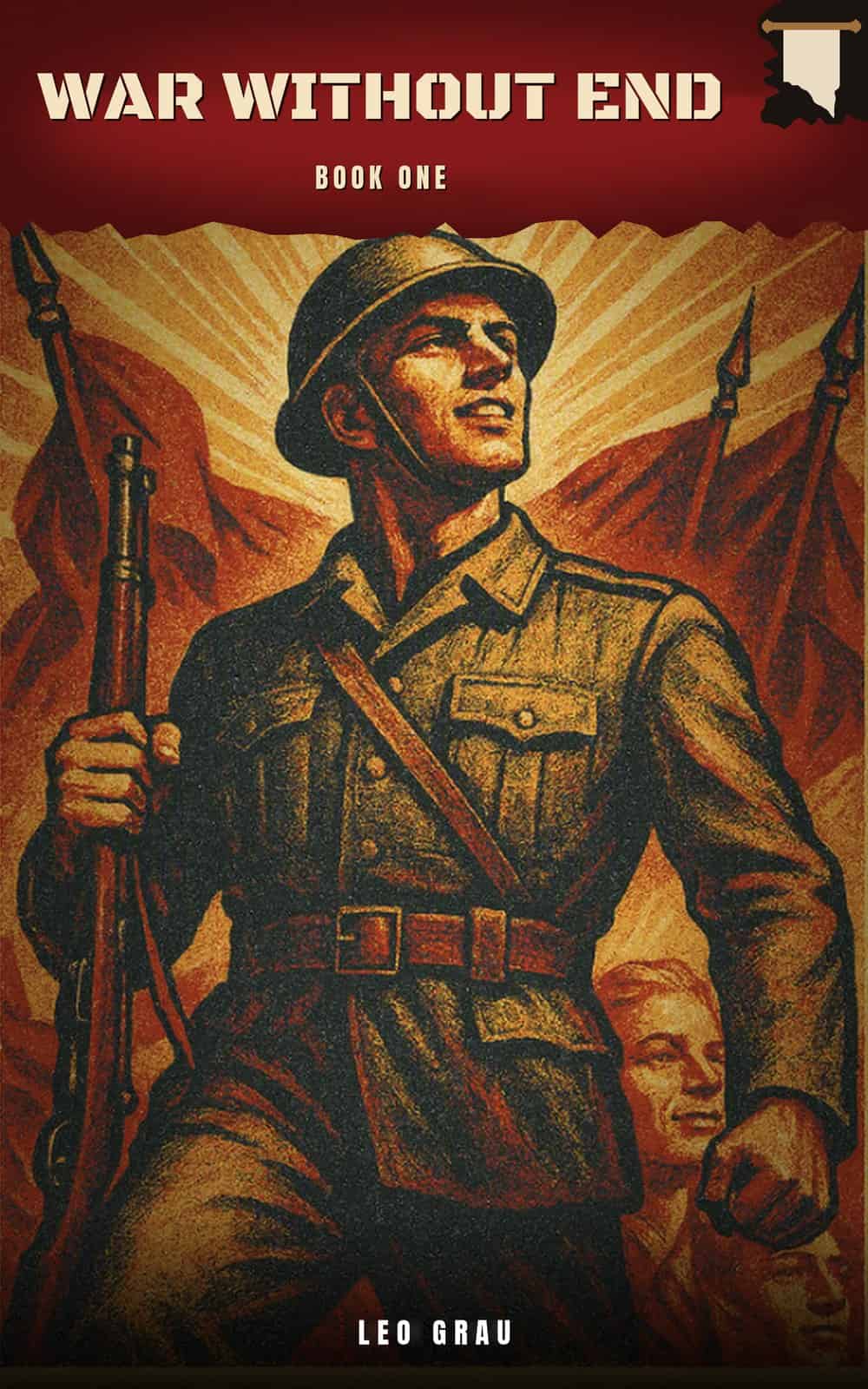
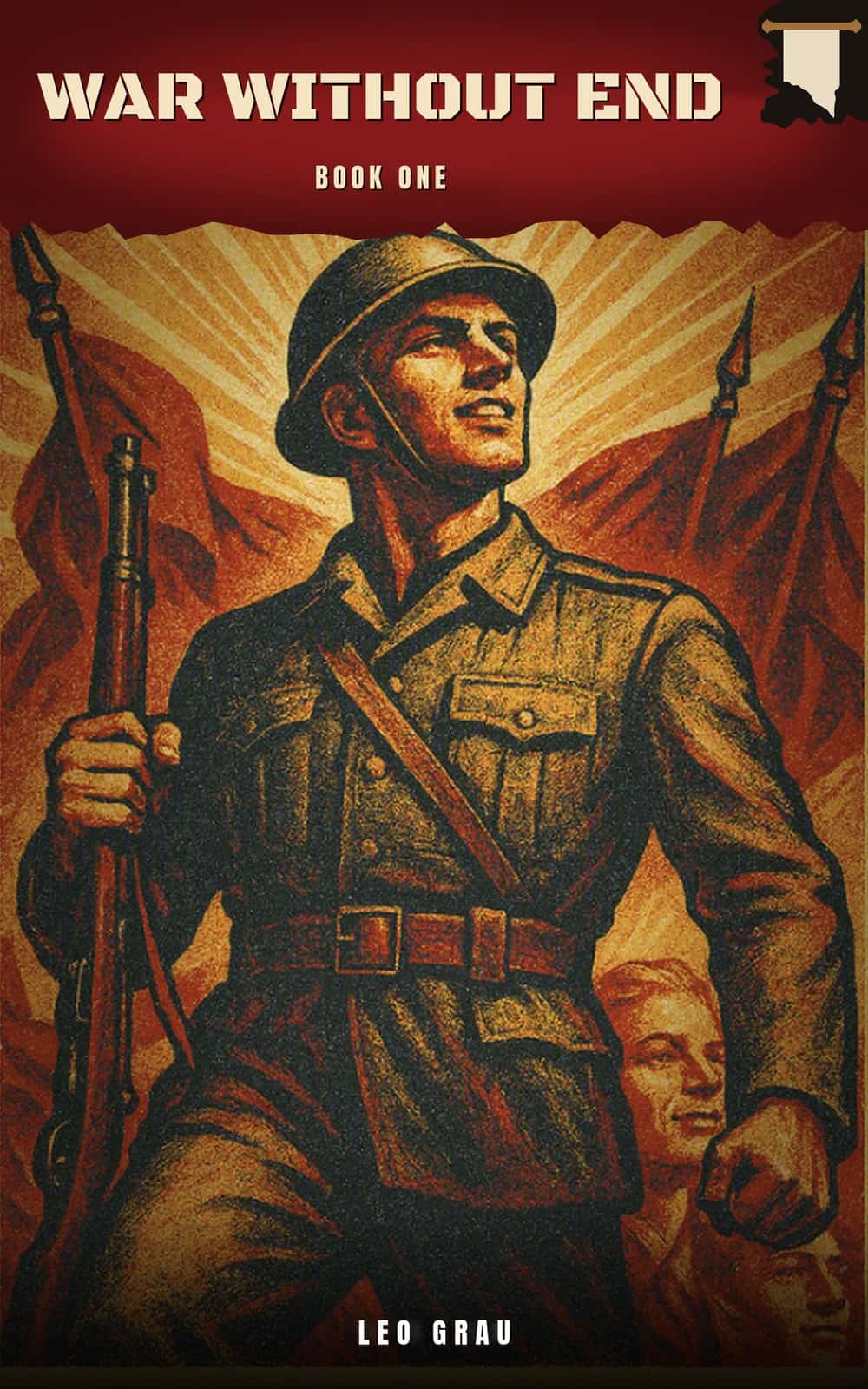
The war takes every boy at fifteen. This year it took Kyle.
- Status
- Pre-order
- Series
- Book 1
- Release date
- Formats
- Kindle
About the book
Fifty-two years of war have taught the Accord one lesson: there are always more fifteen-year-olds.
Every year the drafts go out. Every year the camps fill with boys who have never known a day of peace, and every year the trains carry them to the front.
This year, one of those boys is Kyle. His name is on the roster at Camp Ashford. He gets a cot, a uniform, a squad, and one year to become a soldier.
Then the train comes. The war has taken every class before his. It will take him too, unless he learns to survive it.
Read an excerpt
Read the opening chapters freeHide the sample
Chapter 1
The horn blew one long note at the door, followed by two quick raps on wood. A man's voice came through the wood, pitched to carry the length of a corridor: “Up! Five minutes! Out the field door, dressed and moving — GO!”
Kyle was sitting up before he knew why. His heart went hard behind ribs that felt too close to the skin. His hands had the edge of the cot before he decided anything, and there was no room in him for fright, only for getting up. He moved the way any man on a site moves when the foreman shouts.
He reached out to steady himself against the bedframe and found a wrist that belonged to somebody else. Thin, the bone showing sharp under skin that had never done a day of hard work. It was his, apparently, though it felt like a lie to say so. He pressed his palm flat to the rough wool of the blanket and it came back smooth — no calluses, none of the old scars off slipped hammers and torn nails. There was no time to sit and look at it. He slid off the cot and braced for the pop in his lower back and the grind in his right knee. Neither one came. He landed light.
Around him nine other shapes were getting up in the dark, swinging their legs down, standing, reaching for clothes. Nobody spoke. Nobody even groaned at the hour. The sounds were cloth, and bare feet on floorboards.
Kyle followed them, his hands finding a pile of clothes he had never touched before. The tunic was coarse and hung loose off his shoulders. The trousers weighed nothing — no wallet, no keys, no drag of denim at the hips — and the buttons were small and close-set, made for fingers thinner than the ones he remembered having. He got them wrong twice and did them again from the bottom.
A board hit the floor somewhere to his left with a flat clack. On any site Kyle had worked that was good for a laugh and somebody's name said loudly. Here it got nothing. He kept copying the shapes he could make out in the light under the door, and by the time the last button was through he had his boots in his hands.
The boots were the worst of it, stiff with cold and damp all through, and the leather bit at his heels where they ran a half-size short. The laces had been cut down for fingers thicker than his. He stared at them a second longer than the hurry allowed, wondering what kind of man wore these boots. An older man, he thought. Somebody with feet like his own. Then the boys around him were shuffling for the door, picking up into a trot as it opened, and he went with them.
Kyle stepped into line, his heart keeping time to the shuffle of boots on wood. At the threshold stood a man who was nothing but a silhouette against the glare of the lantern he held high. The light reached the ground and the wide swing of his free arm waving them through, and never once reached Kyle's face. Kyle passed inside arm's length of him, caught old tobacco on him and something metallic under it, like wet pennies, but the man said nothing.
He ducked going through the frame, the door set higher than he had aimed for — or perhaps he was shorter than he remembered being. Out in the passage he was in a current of boys at once, more of them feeding in from doors all down its length, shoulders either side of him and nowhere to put his elbows. At the far end another man stood in shadow with no lantern. As Kyle came up on the turn, this one stepped out into the gap so the whole stream had to bend around his body, and shouted over the noise of all those feet.
“Left at the turn! Field door, straight on! You're LATE — MOVE!” he yelled, pointing his whole arm toward the left passage. “You're LATE—MOVE!”
Kyle went with the rest and took the corner. He got the man sideways on, in passing: older than the one at the door, planted and comfortable with being in the way. The one at the door had been doing a job somebody handed him. This one looked like the man who handed it out.
Some kind of school? That was the shape of it, going by the way they were being moved along in silence. He got that far with the thought, and then the hallway spat him out through the field door and the cold took the rest of it off him.
They came out onto ground a lot of feet had beaten flat. It was still before dawn, and the sky had the color of old concrete. Kyle stopped a step past the door, boots sinking into the mud. A hundred boys were already spreading across the field in the half-dark, more coming through doors from other blocks away down the line. A horn sounded, then another, then another further out, the sound handed along block to block until he lost it.
Kyle stood still among them with his pulse knocking at the collar of his tunic and his eyes on the grey horizon.
“ROOM LINES! Ten to a line, your own room, MOVE!”
The order came across the field and the hundred boys came apart and went looking for each other, turning on the spot, up on their toes. Some took a sleeve and let it go again when the face above it was wrong.
Kyle didn’t have the faces yet. What he had was a shoulder that slumped on one side, and a pair of hands that went on searching the crowd after the rest of the boy had stopped. The two who had slept either side of him found him first, and one took his sleeve and pulled. He went where he was put, fifth in a line of ten. Nine of them had come out of his room in the dark. He was the tenth, and he couldn’t have said one of their names.
The mud took each boot with a soft, wet pull whenever anybody shifted. Three minutes went by. The damp came up through his soles and the cold came down the back of his neck where the collar didn't quite reach, and this body had nothing on it to hold heat. Far off another horn sounded, then another, blocks waking that he couldn't see. He gave up guessing how many hundreds of boys were standing in the dark this morning doing exactly what he was doing.
The standing felt familiar — being counted in a line, waiting on a voice to tell him who he was supposed to be. He reached for it and it slipped away, leaving him the damp cold and the sound of teeth chattering somewhere near his shoulder.
Then the man with the list arrived.
He walked to the head of the first room-line with a clipboard and a pen and started working through the boys. He read each name out flat and whole, the same weight on every one, and made a sharp mark after every answer. Kyle watched his feet. At each boy the man made the same small pivot and held himself exactly one pace back, never closer, never further, the whole way down. Kyle had worked under two or three men who moved like that, the ones who could look at a stack of brick and know it was eighty short. The boys had an economy of their own going, hands in armpits, weight off the wet foot.
When the man reached his line, he stopped at the first boy. The boy spoke, the pen scratched, and the man moved on. Kyle counted down — two, three, four — and got ready for his turn.
“Caius.”
“Here,” Caius said. His voice was steady, but his hands were shoved deep into his pockets, shoulders hunched against the wind. The man with the list didn’t look up. The pen scratched across the paper, marking Caius present.
“Tomas.”
“Yes,” Tomas replied. His voice was thinner than Caius’s, more tentative, but it held. The mark was made; the man pivoted.
After that the names ran together, sounds with no faces on them. Some came out with a desperate sort of strength. One boy’s cracked on the first syllable and he shut his mouth hard and stared straight ahead. Another answered twice, the first lost to a gust of wind or to his own nerve, the second too loud and half an apology. The man marked the paper and went on.
The line shifted around him, boys stepping closer together as their names let them go. They were strangers to him, every one, yet they knew his face. The man stopped directly in front of him. His eyes didn’t rise from the page.
“Kyle.”
“Here,” Kyle said.
It came out easy, and the easiness was what frightened him. The man marked the list and turned toward the last few boys.
A stranger had known his name before Kyle said a word of it himself, and that unsettled him worse than the cold had.
There would be thousands of names going down today, if those horns meant anything. All of it would end in a room somewhere, in a stack, with one man whose whole job was that stack.
The man with the list folded the paper once and slid it into his pocket. He looked toward the line that had just finished.
“Room three — offices. Walk, don’t run. NEXT ROOM — HOLD.”
The line turned together to face the grey silhouettes of buildings across the field, and started walking. Kyle got in behind Caius, who was wide enough across the back to take most of the weather off him, and matched the swing of the boy’s jacket step for step. Walking he could do all day.
The offices were long and low, half sunk into the earth. Same drab grey stone as the dormitories, laid by the same hands or near enough. Doors stood open at regular intervals along the wall, one for each line coming across. Kyle’s block fell into the fifth door. Inside, the room widened into a broad hall with three long tables set across it, and behind them sat men who looked as tired as Kyle felt.
Kyle looked up the queue and did the arithmetic before he decided to. Four blocks in front of his, four hundred boys or more. Three tables. Call it a boy a minute at each. Hours, then — it came as easily as load-weights and man-hours ever had. A pour schedule with people in it instead of concrete.
He knew this kind of waiting, at any rate. He shifted his weight, let the mud dry on his boots, and settled in for it.
Around him the other boys murmured, about the cold mostly, and the breakfast none of them had been given.
He waited for his legs to start complaining. Years of standing on concrete floors had taught them when to start. They stayed quiet. His feet were cold, and that was all.
Between shifts of weight his own life came at him in pieces — sawdust up his nose, a hammer handle in his palm — and went again before he could take hold of either. He let them go.
When his block finally reached the tables, the man at the center station stood up. He had a blunt, heavy face, but his voice carried clearly over the low chatter of the hall.
“NEXT BLOCK — MOVE UP.”
The line surged forward, closing the distance. Kyle was close enough now to hear the questions at the front. Five to every boy, read out in the same bored rhythm. One by one they answered and went off around the corner, leaving a space for the next to fill.
“Name,” the man said as Kyle reached the table.
The voice was flat and toneless, the same as the roll-call man’s; the two of them might have been trained off one sheet of paper. Kyle’s own came out thin in the open air of the hall, and still recognizably his. “Kyle.” He watched the pen go across the form, shapes and lines that meant nothing to him, and listened to it scratch.
“Year of birth,” the man said. Kyle opened his mouth on I don't know, and the flash came before the words did — cold salt spray in his face, the smell of rotting kelp off a winter wind with sting enough in it to drive a man indoors to a warm shop. The date came with it, sudden and certain.
“Two ninety-seven,” Kyle said, slow. He felt the words leave his mouth while he remained somewhere else entirely.
The man’s pen moved again. “Place of birth.”
Another flash, and this one came with sound. Gulls screaming, and under them the slap of water against a quay and the clatter of gutting tables dragged over stone. The name came up whole and heavy in his throat, though he had no memory of ever saying it.
“Ellness,” Kyle told him. The man didn’t look up.
“Father’s trade.”
The third flash was hot and thick with the scent of cedar shavings. Kyle heard the steady tap-tap-tap of a mallet on a chisel and felt the grain of wood under his palm, rough and dry. There was the ghost of a backache across his shoulders and the heat of pitch bubbling in a pot nearby.
“Boatwright.”
The man’s pen paused for a second — maybe he was thinking of boats, maybe he was just bored — then it moved again.
“Kin to notify.”
This flash was the quietest. A small room with a rationed fire that barely warmed the toes, and one chair drawn up empty at the kitchen table where breakfast had already gone cold. There was no sound in it but a clock he couldn’t see. Kyle looked at the blank space where the man’s pen waited. He felt the hollowness of it in his chest.
“None,” he said.
The man marked the box with a quick, final stroke and slid the paper down the length of the table.
Kyle took the paper and stepped back. The next boy stepped up.
At the final table a different man waited with a heavy rubber stamper. He didn’t look at faces, only at the papers sliding his way. The rubber stamp struck paper and wood with a heavy thud.
“Mess hall’s open till noon,” the man said, his voice a rehearsed drone. “Mess hall’s open till noon — follow the path left past the pump, two hundred paces, you’ll see the line. Barracks block after. Kit inspection is TOMORROW at seven — kit’s on your bunk tonight.”
Left, pump, two hundred paces, kit on the bunk. Kyle took the stamped paper and said it back to himself twice on the way out. He couldn’t read a mark on the sheet in his hand, so the words a man gave him out loud were all he had.
He came out onto the office step into late-morning grey. The others from his room were collecting there, counting themselves over without saying anything about it, the way crews always had at the end of a shift. The lane ran straight away from the step, empty, with the pump standing alone a long way down.
They went down the lane in ones and twos. Kyle kept his own pace, passing eight or nine boys from his room who watched him go by, and took the left he had been told to take, counting the paces off because a number he knew beat a number he didn’t. Two hundred, flat the whole way, and then the mess hall.
It was long and low with a vent on the roof spitting grey plumes of steam into the pale air. Boys in grey tunics waited outside the door, shoulders hunched against the cold. Kyle slowed, following the queue back with his eyes toward the pump; there were a hundred at least, and more folding in behind.
A levy, maybe, he thought. Some kind of muster. The whole morning had been sorting — lines, doors, tables, boxes on a form — and not one man had said out loud what it was for. Every history he had ever read had a morning like this in it, men lined up for rations or orders. He didn’t ask anybody, just took his place at the tail of the line and waited.
Standing still brought the ache up into his feet, flat and wide, the one he knew from the back end of a long day. It was the first thing all morning that had felt like his own body. His toes were coming out of numb into a prickling heat, and he found himself standing there enjoying it. Ahead of him the mess hall door went open and shut, open and shut, and boys came back out with wooden bowls held against their chests.
One man on the ladle, from what he could see through the doorway, and a hundred boys outside it. Nobody had put a second man on, and Kyle guessed that was because there wasn't one to put on — all morning the place had been short of grown men and long on boys. They could stand here all day if they had to, he thought.
Two places ahead, a boy leaned toward his neighbor and whispered, “Told you it’d take longer than the roster.” The other boy shrugged, his shoulders pulling tight against his tunic.
Kyle looked at their hands. One pair had the hard, yellowed calluses that rope leaves, ridged across the base of the fingers. The other had thin white scars crossing the knuckles, the kind a net leaves. Those were working hands, he thought, paid for outdoor work not long past, and that put a warmth in Kyle’s chest that caught him out. New crew, he thought. First morning in a strange place and he was already sorting them by who could pull a weight. He kept his mouth shut. A grown man’s interest coming out of a face like his would read wrong.
The man with the ladle worked alone behind the pots, eyes down on the bowls. Steam came up off them and Kyle could see his hands and his chin and not much else. The ladle dropped something thick and pale into Kyle’s bowl. A heel of bread went onto the rim. The man pointed past him. “One each. Keep moving,” he said.
Kyle took the bowl, hot right through the wood against his palms, and looked for somewhere to sit. The room was wide and dim, warmed by two hundred bodies and the stoves behind the serving wall. The noise stayed low, almost hushed. Men and boys sat side by side along the trestles, hunched over their food. Kyle found a place at a table where Caius had already sat down; he slid onto the bench across from him, and Tomas settled two places along.
He took his first spoonful. Thick and salted, tasting of very little, and hot enough to sit in his stomach with some weight to it. It asked nothing of him, and he sat with that a moment.
The warmth spread through his chest and made his head feel light and simple. Across from him Caius ate fast, checking the room between mouthfuls for anybody coming to interrupt. Tomas had his head down, working through his bowl in order.
“Kit inspection’s tomorrow,” Caius said to Tomas, leaning in toward him but keeping his voice low. “Better sort yours tonight, not at the last minute.”
Tomas swallowed a mouthful of bread. “Yeah,” he replied.
Kyle went back to his food and listened. Spoons scraping the bottoms of bowls, a low hum of talk nobody was really attending to. He stayed out of it.
That was twice now that tomorrow had been mentioned — the man at the last table, and now here. Tomorrow at seven, then. He went back over the morning while he chased the last of the broth around the bowl. A horn in the dark, a line in the mud, a form filled out by another man’s hand, and this.
His feet were throbbing properly now that they had stopped, the blood coming back in slow, insistent pushes. He looked down the table at the rest of them, young faces, most too young to have earned a tiredness that lived this deep in the bones.
“Mess closes at noon — finish up, don’t dawdle,” the man with the ladle called out to the room.
Benches emptied as boys rose in twos and threes, carrying their bowls to the stacks at the end of the tables. Kyle didn’t rush. He finished the last of the broth, licked the salt from his lips, and set his bowl carefully on the pile.
He followed Caius and Tomas toward the door and out into a lane that had got colder while they were inside. The cold went straight back into his joints, and he caught himself waiting on the knee to go with it. The knee stayed quiet. He kept the bread. It stayed closed up in his fist, going cold against his palm, and he said nothing to anybody the whole way down the lane.
Chapter 2
The issue store was smaller than the mess hall and twice as loud, crates knocking against crates, boots shifting on boards, a couple of hundred boys in a room built for fewer and none of them standing still. Kyle came up with his roommates to a wide wooden table that had been dragged out in front of the counter, their shoulders against his back the whole way. There was no order to the line. It was a slow push of bodies that surged forward every time the man at the table slowed down.
He handed over his stamped paper without looking at it and watched the man take it and lay it flat on the wood. The man had broad hands with the knuckles scarred across the top, and he held the pen with delicate precision. The ink on the page was shapes to Kyle. One of them had a long tail that hooked back under itself, and he looked at it twice and got nothing out of it either time.
The man began copying entries into a thick ledger, saying each one out loud as he wrote it down: Kyle's name, his station, a mark on the page. It was his own life, recited by a stranger. Behind him the boys pressed closer, close enough that he could hear them breathing in the gaps between the words.
It would take hours to get through them all. Kyle worked his jaw loose and kept his face where it was.
The man reached the birth line and slowed down. His finger went along the shapes on the stamped paper before the pen went after them. He read the date out—two ninety-seven—and then the age that came off it.
Kyle's hand closed on the edge of the table. Fifteen. The number sat on him and fitted nowhere, and under it ran the other thing, his own birthday, the real one, still in his head where the pen could not get at it. Correcting the man would cost more than he had left today, and there was no arguing with ink already drying. A foreman signed off a job that was finished and the paper made it so, and nobody went back to the paper after that. Behind him, Caius and Tomas said nothing.
Kyle looked at the man and answered to fifteen.
The pen moved down to the line for kin. The man read off Kyle's paper that there was no one, and he copied the blank into his book without asking for proof and without looking up. Was this how it went for every boy in the line, then—some with names to give, mothers or fathers or brothers, all of it set down in the same level tone?
The nib scratched twice and stopped. Kyle stood with his hands at his sides, his thumb working the seam of his trouser leg. The empty line brought back the flash from the office table that morning, one chair drawn up empty at the kitchen table where breakfast had already gone cold. His mother and father should have been there. The man had his pen on the next line already.
He asked for Kyle's own trade without looking up, and Kyle told him the boatyard. It went into the book without a pause, the pen turning small tight loops. Had the man ever stood on a dock in his life, or was everything out here the same grey stone and iron as their courtyard? If he had ever seen a boat, he would want to know how it could be taken apart, or what it could carry.
The entry closed with one hard stroke and the man called for the next boy. Kyle stepped away, his boots loud on the floorboards, and felt the line shut the gap behind him before he had properly cleared it. Nobody looked twice at him going; to them this was just another station to pass through, as ordinary as the mess hall or the latrines. Up at the counter Tomas was waiting with his shoulders pulled in and his weight on one leg, and Caius stood behind him shifting his weight from foot to foot. Kyle went and stood by Tomas.
The issue counter was long and scarred from use, and the boots were behind it: pairs worn in with the creases set deep, standing next to stiff ones that held their own shape on the shelf. A pair of hands went along the row, sliding pairs this way and that, working down the counter as the line came up.
Tomas had reached his turn. He did not ask for a size and he did not say anything. He leaned over, turned one boot up in his hands and looked down into the throat of it, set it back, and pulled the next pair off the shelf in one motion. The man behind the counter nodded at him and moved on to the next boy. Not a word either way.
Kyle watched the whole thing and understood none of it. No papers here, at least, and nothing to answer. He stepped up when the line gave him the room and kept his eyes on the boots.
Looking inside a boot. For what, the wear? Or for what the last boy had left in it—a coin, a bit of string, something that had meant something to somebody. Kyle did not know this place well enough yet to back his own guess over another man's hands, so he did exactly what Tomas had done. He turned a boot over, squinted into the dark of it, set it back and reached for the next pair. It was the way a foreman on a strange site might copy the motions of a local hand before he understood why they were done.
The man behind the counter shifted his weight and waited on him. There was something funny about it, he thought—a line of them working through a selection that wouldn't change where any of them were going.
Two pairs were left in front of him, one with the leather gone soft and bowed over at the ankle, the other standing up stiff. New was better. New meant less chance of a blister, and no hole worn through the sole where he could not see it. It was a small thing to decide, and he was glad to have decided something. He drew the stiff pair toward him and slid them off the shelf.
They were heavier than he had figured, and his hands liked that before his head had anything to say about it. He turned one over and pushed his thumb across the grain. The leather caught at his skin and did not give under it.
Under the pleasure of holding something new sat the other half. He still did not know what Tomas had been looking for down the throat of that boot, and he had stood here and copied the boy's hands anyway. He kept hold of the boots all the same.
Tomas had already gone on past the counter. The line came up behind and the warm place at Kyle's shoulder went empty.
The man behind the counter never once looked at a face. He slid the next pair across the wood with his free hand already back on the shelf for the pair after that, before the boy in front of him had the first one off the counter.
Kyle stood where he was with the new boots held against his chest, one hand under each, while the issue went on down the counter without him. The man behind the counter did not hurry him; maybe he had seen enough boys through here to know some would linger longer than others. Behind Kyle the room was still full of them, boys moving at their own speeds toward whatever waited past the counter, taking what they were given and going on.
The grey outside had gone another shade down by the time the horn called them to eat, a sound like something heavy dragged over stone, and it got into Kyle's teeth. Every place he had ever worked ran on a bell or a whistle or a man shouting. This was the same clock with a worse voice.
He went with the flow of boys into the mess hall, where the air was boiled grain and salt. Caius and Tomas were already ahead of him, so he fell in behind and let their shoulders steer him through the press until they reached a long bench that ran the length of one wall. His roommates took one side of the table, and the boys out of the next room sat down across a narrow aisle from them.
They ate in a low hum of talk, the kind of noise he knew from break rooms on a job site, where everybody says something and nobody says much. Spoons knocked on wooden bowls. Names went round the table, thrown out as greetings or as questions, and Kyle took them by ear and weighed what he could hold on to. A few stayed—Caius, Tomas. Most went past him and left behind a face and the shape a mouth had made saying it. Two boys further down came apart in his head only by the way one chewed, slower than the other, and another kept his eyes on the door the whole time he ate, and he noted whose hands shook without putting a name to it.
A horn sounded once, and down the bench the boys who had finished got up with their bowls and carried them to the end of the table, one going on top of the other into a tall careful pile that a strong breath would have taken over. They did it without anybody saying anything, and the end of the table stayed empty behind them.
Kyle watched them do it and still could not find the sense in it. On the sites he had worked, a rule that looked stupid always had something behind it. Here he could see the rule and none of the reason, and that bothered him more than being hungry had. Who came for them, then, and what was wrong with leaving a bowl where a boy had eaten from it? He kept his seat and kept his hand on his bowl. “Why do we stack them there?” he asked the boy closest to him.
The bench went on as it had been going. Spoons kept moving. The boy two places down went on telling somebody about the cold. The one Kyle had asked reached across him for the bowl nearest his elbow. “They stay there till someone takes them,” the boy said without looking up.
Kyle looked at the pile of wood, and then at the boy's hands, already going after the next bowl. Counting bowls was a quick way to count boys without counting a boy twice. That was his guess, and he kept it.
The brush-off landed under his ribs, smaller than he had expected. First question he had asked anybody all day, and he had spent it on bowls. He let it go and went back to his own.
The food was warm and thick as soup and tasted mostly of salt. It sat heavy in him, which was all he had wanted out of it.
Across the table a boy with a thin face and hair like bird's down was trading bread. He gave up three good chunks of it for one small piece of something dried, paying it over with no haggling in him at all, and the boy he paid it to took the trade and made nothing of it.
Whatever the dried piece was worth to the thin-faced boy, that was the only price in it that mattered. What was it, and where did a boy in here come by it? He kept the wanting to himself.
Beside him Caius was talking, slow and low, the words threading along under the noise of the room until he got to something Tomas did not like. Tomas shook his head and pushed back at him, ready to go round on it. Caius did not climb up to meet him. He said one short sentence, and when Tomas came at it again he said the same sentence over, word for word, at the same pitch both times.
Tomas went quiet and put his attention back in his bowl. Kyle thought that was a good trick and worth keeping. There was something tired in it too, in the way Caius's voice hadn't shifted pitch between the two times he'd said it.
Halfway down the bench a quiet boy with his chin down in his collar pushed half his ration across to the boy sitting next to him. He did not ask whether the other one was hungry and he made nothing of the handing over. He slid the bowl across the wood the way a man gives back something he borrowed. The other boy looked at him once and then ate it fast, head down.
Kyle caught the quiet one's eye for about a second before the kid looked back into his food.
He went back to his food with the heat of it on one side of him and the cold coming off the stone wall on the other.
The horn went again. The sound came up through the bench and rattled his spoon in the bowl, and the talk stopped in the middle of itself. The boys stood and took their bowls down to the end of the table without being told. Kyle tried to put the names back together while they rose—the ones spoken earlier, and they would not hold, they slid off and left nothing behind them. Caius. Tomas. The rest had gone already.
He carried his own bowl down to the end of the table and set it square on top of the pile so it would not take the stack over, and went out after Caius, wondering if the faces at this bench would still be faces to him in a month, or if they would have gone the way of the names already, blurring together like the boys from the next room.
In the series
Book 1 in War Without End.
About the author
- Leo Grau
Leo Grau is a fantasy author and the writer of War Without End, a military fantasy series. His stories draw on a mix of reality and a touch of fantasy: the weight of real war, set in worlds of their own.